Artificial Intellignce and Machine Learning
Artificial Intelligence
What do we mean here by “artificial intelligence” (AI)?
For practical purposes, we mean “textbook” AI.
What textbook?
“The authoritative, most-used AI textbook”, of course.
Let’s take a look at the table of contents (toc) for this book.
It’s interesting to compare the differences in the toc between the 3rd and 4th editions of the book.
Some Quotes
Along with molecular biology, AI is regularly cited as the “field I would most like to be in” by scientists in other disciplines.
The field of AI “attempts not just to understand but also to build intelligent entities.”
“AI is relevant to any intellectual task; it is truly a universal field.”
What is Textbook AI?
Here are some definitions:
The automation of activities that we associate with human thinking, activities such as decision-making, problem solving, learning, etc.
The art of creating machines that perform functions that require intelligence when performed by people.
The study of the computations that make it possible to perceive, reason, and act.
AI is concerned with intelligent behavior in artifacts.
Components of AI
| Human Performance | Rationality | |
|---|---|---|
| Reasoning | Thinking humanly | Thinking rationally |
| Behavior | Acting humanly | Acting rationally |
Human centered approaches involve observations and hypotheses about human behavior.
Rationalist approaches involves mathematics and engineering.
Question: For which of the four categories is the Turing test most relevant?
Question: Which capabilities would a computer need to possess to act humanly?
Elements of Applied AI
Robotic vehicles
Image recognition or computer vision
Game playing
Logistics
Robotics
AI and ML
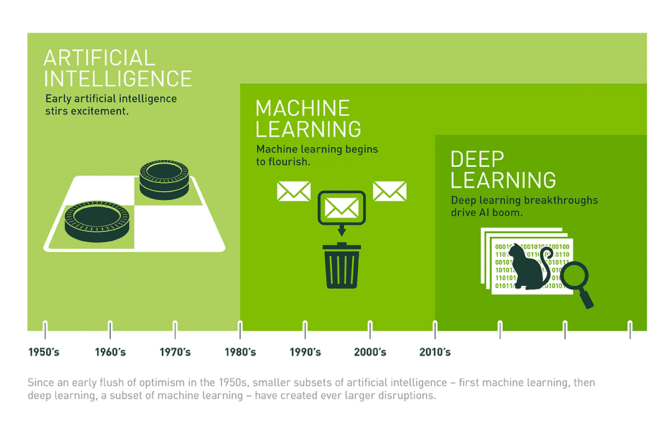
AI Methods
The Role of Models
I argue that an important distinction between machine learning (ML) based AI and other types of AI is the role that models play.
We will set up a context for models as relevant for ML starting with an example from physics.
Intro to ML
A computer program is said to learn from experience \(E\) with respect to some class of tasks \(T\), and performance measure \(P\), if its performance at tasks in \(T\), as measured by \(P\), improves with experience \(E\).1
We use machine learning when we want to build a model but don’t know or can’t easily describe exact underlying mechanisms.
There are three common types of ML:
Supervised learning which consists of two types of problems: classification and regression
Common ML Methods
Common ML methods include
Let’s describe linear regression as a ML method.
Further Considerations
Flexibility versus Interpretability
Overfitting
Bias versus Variance
Deep Learning
Deep learning is a machine learning framework that uses neural networks to build models.
Let’s examine a list of applications for deep learning.
In the next lecture we will explore neural networks and deep learning together in detail.